Breakfast · Global
Hard-Boiled Eggs
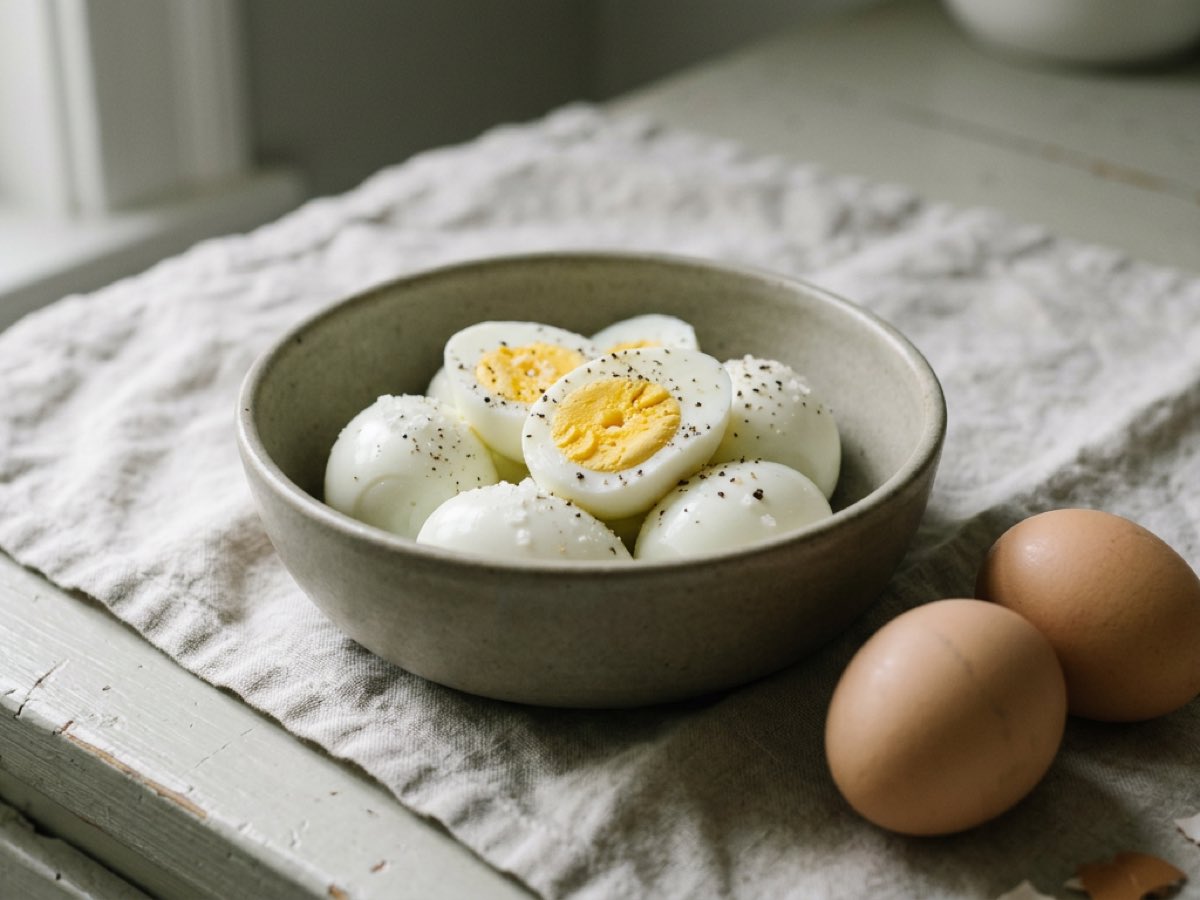
Firm, bright yolks with no grey ring, and shells that actually come off.
- Hands-on
- 10 min
- Hands-off
- 35 min
- Total
- 45 min
- Makes
- 6 eggs
- Serves
- 6
About 10 minutes to bring the water to a boil (our estimate; it depends on your pan and stove), 15 minutes standing in the hot water for large eggs, then about 15 minutes in ice water. Peeling takes a few more minutes. Total = 5 min active (setting up and peeling) + 40 min hands-off (heating, standing, ice water).
- easy
- vegetarian
- gluten-free
- dairy-free
- baking-basics
- make-ahead
- lunch
- pantry
Verified against at least two trusted test kitchens or food-safety guides · Last checked · What this means
Scaling? Any number works as long as the eggs sit in a single layer and the water covers them by 2.5 cm (1 in). A bigger pot of water takes longer to boil, but the standing time stays the same. Some items (like eggs) don’t halve neatly: beat them, then measure out half.
Ingredients
You need: saucepan wide enough to hold the eggs in one layer, with a lid · slotted spoon · medium bowl for the ice water · timer
Contains: egg
Method
Eggs in, cold water on
Lay the 6 eggs in a single layer in the saucepan. Pour in cold water until it covers them by 2.5 cm (1 in).
Bring to a boil
Set the pan over high heat and bring the water to a boil.
Ready when: Big bubbles break across the whole surface. Turn off the heat as soon as you see them.
Otto tried this firstOtto leaves the eggs boiling hard for 20 minutes "to be safe". The yolks come out crumbly with a grey-green ring and the kitchen smells of sulfur. Fierce heat is what causes both, so he starts again and takes the pan off the heat at the boil.Cover and let stand
Move the pan off the burner, put the lid on and let the eggs sit in the hot water. Large eggs: 15 minutes. Medium eggs: 12 minutes. Extra-large eggs: 18 minutes. While they wait, fill a bowl with about 1 L (1 quart) of water and a dozen ice cubes.
Ready when: Cut one egg in half to check: the white and the yolk are both completely firm, with no wet or runny centre. Firm white and yolk is the safe point for eggs. If the yolk is still soft, put the rest back in the hot water for 2 to 3 minutes more.
Cool in ice water
Pour off the hot water. Lift the eggs into the ice water with the slotted spoon and leave them until they are cold all the way through, about 15 minutes.
Ready when: The eggs feel cold in your hand, not warm in the middle.
Peel
Tap each egg gently on the counter all over to crack the shell, then roll it between your hands to loosen it. Start peeling at the wide end, where the air pocket is, and hold the egg under cold running water as you go.
Eat or refrigerate
Eat the eggs straight away or put them in the fridge, peeled or in their shells, within 2 hours of cooking.
Make ahead, store & reheat
- Make ahead
- Hard-boiled eggs are a good make-ahead food: cook a batch and keep them in the fridge for up to 1 week (see storage).
- Storage
- Refrigerate within 2 hours of cooking, at 4°C (40°F) or below. Eat within 1 week, whether they are still in the shell or peeled.
If something goes wrong
- Grey-green ring around the yolk and a sulfur smell Why: The eggs were cooked too long or too hot, or they cooled slowly.
Take the pan off the heat as soon as it boils, let the eggs stand covered, and move them into ice water straight away. - The shell sticks and tears the white Why: The shell wasn't cracked enough, or you started on the narrow end.
Crack the egg all over and roll it to loosen the shell, then start at the wide end with the air pocket and peel under cold running water.
Good to know
- Another way that works: lower the eggs gently into water that is already boiling, keep it at a gentle boil for 12 minutes, then chill them in ice water for at least 10 minutes.
- Room-temperature eggs cook a little faster than eggs straight from the fridge.
- The ice bath stops the cooking. Skip it and the yolks keep cooking in their own heat.
Safety
- Cook eggs until both the white and the yolk are firm; that is the safe point for eggs. Soft or runny yolks are not part of this recipe.
- Don't leave cooked eggs out of the fridge for more than 2 hours (1 hour if it's above 32°C / 90°F). Bacteria grow fast in warm egg dishes.
- Boiling water and steam scald. An adult should lift the pan and pour off the hot water; kids can help with the cold peeling step.