Soups · Japanese
Miso Soup
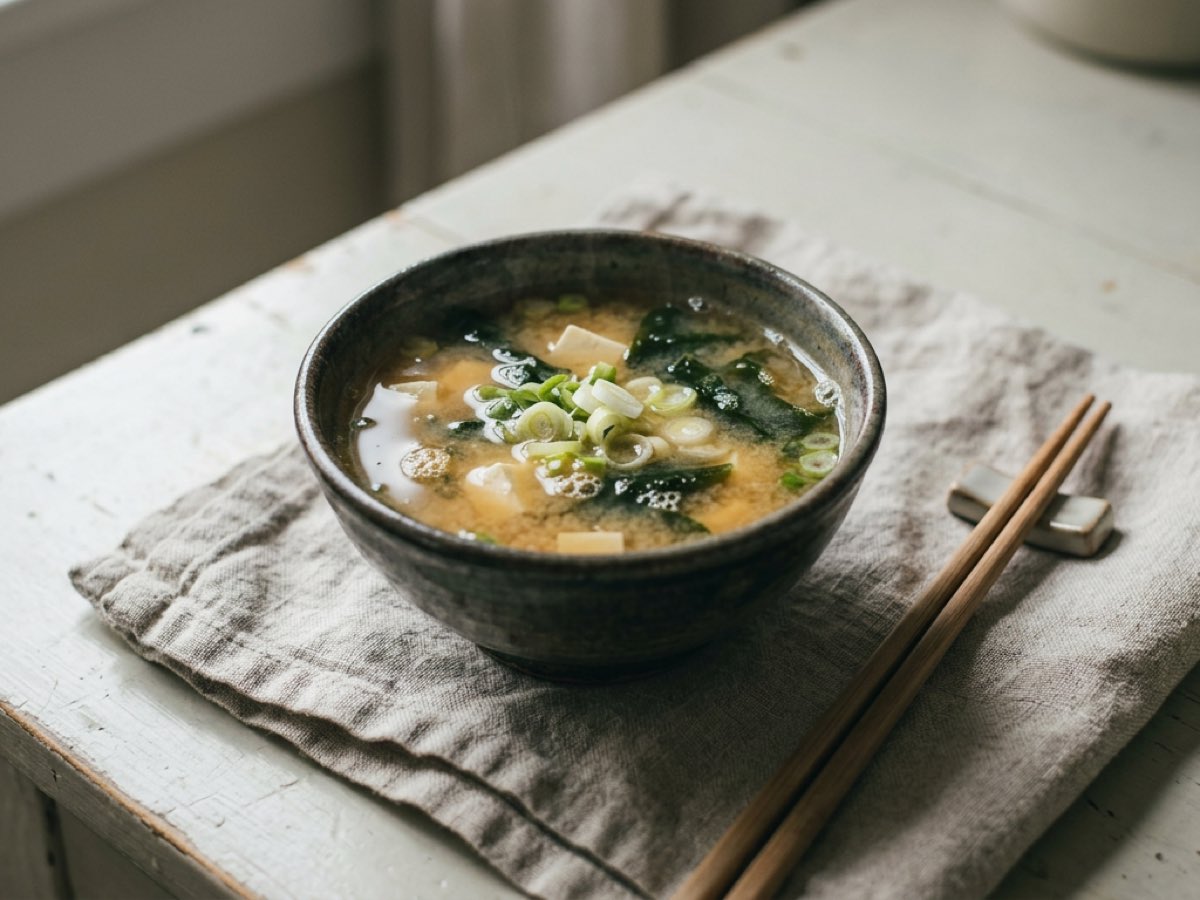
A clear homemade dashi, two kinds of miso, silky tofu and wakame: a calm little bowl of savoury warmth.
- Hands-on
- 35 min
- Hands-off
- 1 h
- Total
- 1 h 35 min
- Makes
- 4 small bowls
- Serves
- 4
The kombu soaks in cold water for at least 1 hour (up to 8, so you can start it in the morning). After that it's about 35 minutes of hands-on cooking. Total = 35 min active + 60 min soaking. The miso is store-bought; nothing is fermented at home.
- easy
- quick-dinner
- light
- make-ahead
Verified against at least two trusted test kitchens or food-safety guides · Last checked · What this means
Scaling? Scales evenly, but miso saltiness varies a lot between brands: when you double it, add the miso a spoonful at a time and taste before adding the rest. Some items (like eggs) don’t halve neatly: beat them, then measure out half.
Ingredients
You need: medium saucepan · large fine-mesh strainer lined with a double layer of cheesecloth · small fine-mesh strainer · large bowl or 2-litre jug · thermometer (recommended) · tongs or a slotted spoon · wooden spoon or small whisk
Contains: soy · fish
Method
Soak the kombu
Put 28 g (1 oz) kombu and 1.2 litres (5 cups) cold water in the saucepan and leave it to soak for at least 1 hour, or up to 8 hours.
Otto tried this firstOtto starts scrubbing the kombu under the tap. Its surface holds flavour, so he stops and just wipes it gently with a dry or barely damp cloth.Heat gently, lift out the kombu
Set the cheesecloth-lined strainer over the bowl. Heat the kombu water over medium-low heat until it reaches 65°C (150°F), 7 to 8 minutes, then lift out the kombu with tongs.
Ready when: Steaming, with small bubbles clinging to the bottom and sides of the pan but not rising to the surface.
Bring almost to a boil
Turn the heat to high and heat until the water reaches 93°C (200°F), about 3 minutes. Don't let it boil.
Ready when: Bubbles break the surface only around the edges of the pan.
Steep the bonito, strain
Take the pan off the heat, add 28 g (1 oz) katsuobushi and steep for 3 minutes. Pour through the lined strainer. Gather the cheesecloth into a bundle, press it only lightly, then throw it away and rinse the pan.
Ready when: Off the heat: the bonito flakes sink to the bottom; the strained dashi is clear and pale gold.
Soak the wakame
Put 4 tsp dried wakame in a bowl and cover it with 180 ml (3/4 cup) cold water.
Rewarm the dashi
Pour the dashi back into the clean pan and bring it to a bare simmer over medium heat, then turn the heat to low to keep it warm.
Ready when: A few lazy bubbles; steaming, not boiling.
Dissolve the miso
Put 2 tbsp white miso and 2 tbsp red miso in the small strainer and lower it into the dashi so the miso is covered but the rim stays above the liquid. Press the miso through with a spoon until no lumps remain. From now on, don't let the soup boil.
Ready when: The soup is evenly cloudy with no lumps left in the strainer.
Add wakame and scallion
Squeeze the wakame dry, cut any pieces bigger than 4 cm (1 1/2 in) into bite-size pieces, and add it to the pot with the sliced scallion.
Warm the tofu and serve
Gently stir in the 170 g (6 oz) cubed tofu and heat for about 1 minute. Serve right away.
Ready when: The tofu is warm through and the soup is steaming hot but not boiling.
Swaps
- Instead of 2 tbsp white + 2 tbsp red miso: 4 tbsp (1/4 cup) white miso only Gives a milder, sweeter soup.
- Instead of silken tofu: soft tofu Same amount and size of cubes.
- Instead of homemade dashi: chicken or vegetable broth mixed with water, 2 parts broth to 1 part water A quick pantry version. Made with vegetable broth, the soup has no fish in it.
Make ahead, store & reheat
- Make ahead
- Make the dashi up to 2 days ahead and keep it covered in the fridge, then finish the soup just before serving; it's at its best fresh.
- Storage
- Miso soup is best eaten as soon as it's made. Leftovers keep, covered in the fridge, for up to 3 days; store any fresh scallion separately and add it after reheating.
- Reheat
- Warm gently over low heat until steaming. Don't let it boil.
If something goes wrong
- Lumps of miso in the soup Why: The miso was stirred straight into the pot.
Press it through a small strainer, or whisk it with about 1 cup of the warm dashi in a bowl until smooth, then stir that back in. - Dashi tastes fishy or harsh Why: The bonito flakes were squeezed hard, or the dashi boiled.
Keep it below a boil and press the cheesecloth bundle only lightly.
Good to know
- Wipe kombu with a dry or barely damp cloth instead of washing it: the surface holds flavour.
- Kombu, katsuobushi and wakame are sold in the international aisle of many supermarkets and in Asian groceries.
Safety
- Contains fish (bonito flakes) and soy (miso, tofu). Miso recipes differ between brands, so read the label for any other allergens.
- Hot broth scalds. Strain away from you, and let kids' bowls cool a little before serving.