Soups · Japanese
Shoyu Ramen
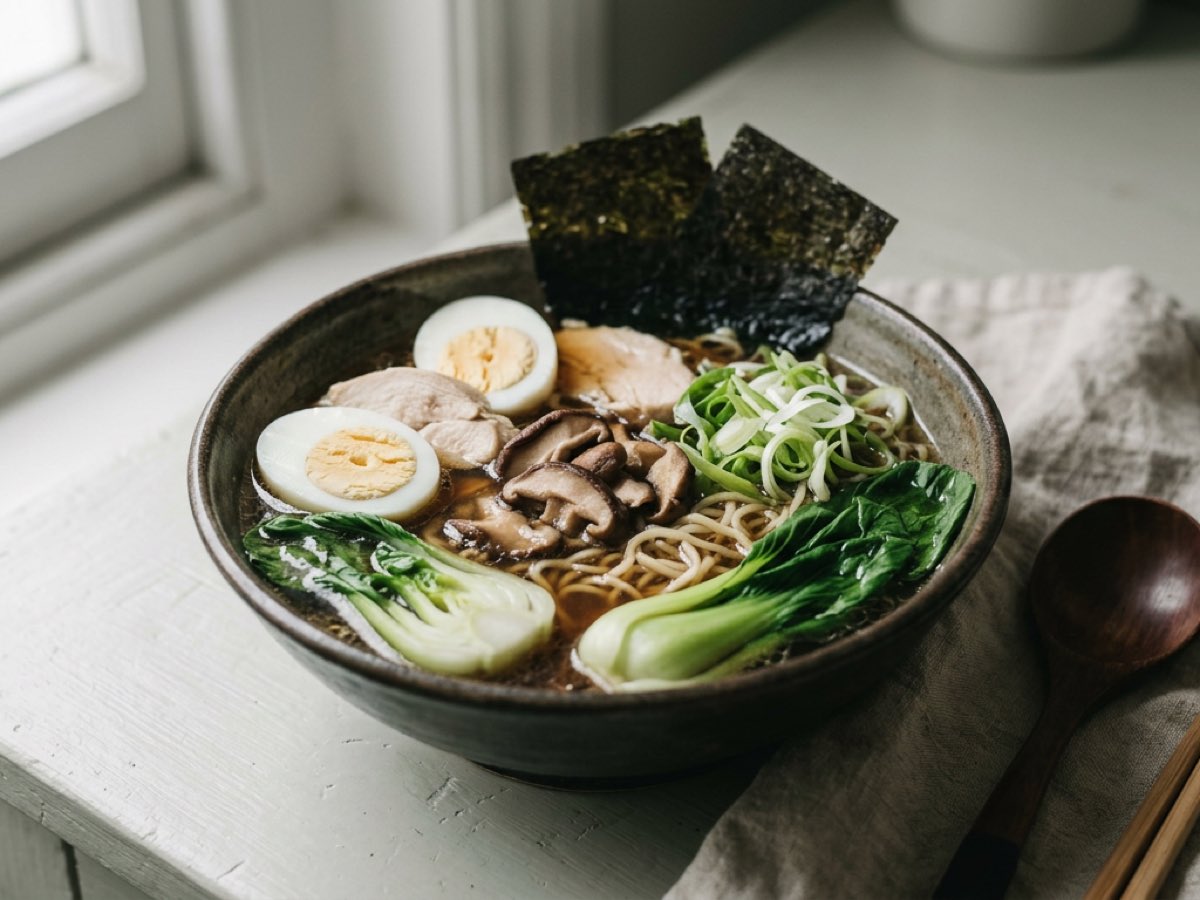
A quick soy-sauce tare, good chicken broth and springy noodles, topped with poached chicken, greens and a hard-boiled egg.
- Hands-on
- 30 min
- Hands-off
- 35 min
- Total
- 1 h 5 min
- Makes
- 4 bowls
- Serves
- 4
About 15 minutes of slicing and setting up, 15 minutes making the tare, cooking the greens and noodles and building the bowls, and about 35 minutes of hands-off poaching for the chicken. Total = 30 min active + 35 min hands-off. Hard-boil the eggs ahead of time; they aren't counted here.
- medium
- noodles
- weekend-project
- comfort-food
Verified against at least two trusted test kitchens or food-safety guides · Last checked · What this means
Scaling? Each bowl gets the same measures: 35 ml tare, 300 ml hot broth and one 130 g portion of noodles. Multiply those per bowl. One batch of tare is enough for 4 to 5 bowls. Some items (like eggs) don’t halve neatly: beat them, then measure out half.
Ingredients
You need: small saucepan (tare) · medium saucepan with a lid (broth and chicken) · large pot (noodles) · frying pan · separate chopping board for raw chicken · instant-read thermometer · colander · ladle · 4 deep noodle bowls
Contains: soy · wheat · egg · sesame
Method
Make the tare
In a small saucepan, combine 150 ml (2/3 cup) dark soy sauce, 20 ml (4 tsp) tamari, 1 tsp mirin and a scant 1 tsp sugar. Set it over high heat and stir until the sugar dissolves, then take it off the heat just before it boils.
Ready when: The sugar has dissolved and tiny bubbles are just starting at the edge. Don't let it boil.
Poach the chicken in the broth
Bring the 1.2 L (5 cups) broth to a simmer in the medium saucepan. Add the 2 chicken breasts, turn the heat down until only an occasional bubble rises, and set the lid on loosely. Cook about 30 minutes, then start checking; it can take up to 10 minutes more.
Ready when: The thickest part of each breast reads at least 74°C (165°F) and the meat is white all the way through.
Otto tried this firstOtto pulls the chicken at 30 minutes because 'the recipe said 30'. The thermometer reads 66°C. The clock is a guide; 74°C (165°F) is the rule.Rest and slice
Lift the chicken onto a clean board (not the raw-chicken board), let it rest a few minutes and slice it. Keep the broth in the pan for the bowls.
Cook the greens
Heat 40 ml (2 1/2 tbsp) oil in a frying pan over medium-high heat and toss the 80 g (3 oz) shiitake and 160 g (5 1/2 oz) pak choi for 3 to 4 minutes.
Ready when: The mushrooms are soft and the pak choi is bright green and just wilted.
Cook the noodles, reheat the broth
Bring a large pot of water to a boil and cook the 520 g (18 oz) fresh noodles following the package directions, then drain well. Meanwhile, bring the broth back to a boil.
Ready when: The noodles are tender but still springy; the broth is at a full boil.
Otto tried this firstOtto drops the raw noodles straight into the broth pot to save washing up. They're meant to boil in their own big pot of water and be drained first, so the broth stays clear and measured.Build the bowls
Put 35 ml (about 2 1/2 tbsp) tare and 1/2 tsp sesame oil in each bowl. Pour in 300 ml (1 1/4 cups) boiling broth and stir, then add a portion of noodles. Top with chicken slices, the greens, two egg halves, spring onions and two pieces of nori. Serve right away.
Swaps
- Instead of dark tare: light tare: 150 ml (2/3 cup) light soy sauce, 2 tsp mirin, 2 tsp sugar and 1 tsp umami seasoning (MSG) Same method: heat until the sugar dissolves and take it off just before it boils.
- Instead of fresh ramen noodles: dried ramen noodles Cook them following the packet directions.
Make ahead, store & reheat
- Make ahead
- Make the tare first so it's ready; it only takes a few minutes. Hard-boil and peel the eggs ahead of time.
- Storage
- Refrigerate leftover broth and chicken within 2 hours in covered containers and use them within 3 to 4 days. Store noodles separately from the broth.
- Reheat
- Bring the broth back to a boil before building a bowl; reheat chicken until steaming hot (74°C / 165°F).
If something goes wrong
- Broth tastes flat Why: Not enough tare for the amount of broth.
Stick to about 35 ml tare per 300 ml broth, and taste before adding the noodles. - Too salty Why: Too much tare, or a salted broth.
Use low-sodium broth, and start with 30 ml tare per bowl, adding more to taste.
Good to know
- Fermented bamboo shoots (menma) and a few celery or mitsuba leaves make classic extra toppings; menma is sold at Asian grocers.
- Halved baby corn is another easy topping: toss it in the pan with the greens.
Safety
- Raw chicken can carry harmful bacteria. Use a separate board, don't rinse it, and slice the cooked chicken on a clean board.
- Check the chicken with a thermometer: at least 74°C (165°F).
- Use eggs cooked until both yolk and white are firm. Soft, runny-yolk ramen eggs are a classic, but we don't use undercooked eggs here.
- You'll be ladling boiling broth into bowls. Set the bowls on a steady counter, pour slowly, and let kids carry them only once they've cooled a little.